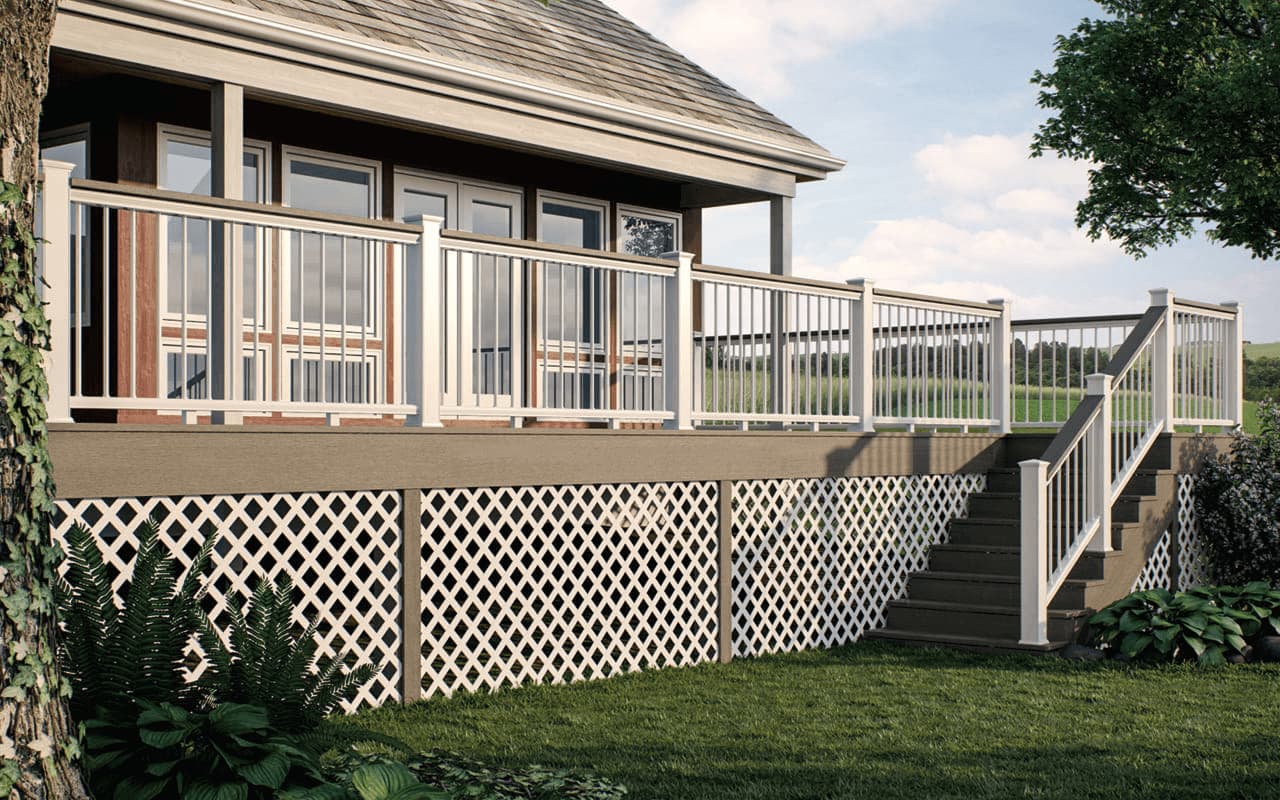
Product Installation and Knowledge

PRODUCT KNOWLEDGE CENTER
Expert Deck, Railing & Outdoor Living Information
Whether you're a homeowner planning your first deck project or a professional contractor looking for installation information, Deck Expressions is here to help you choose the right products and understand how they work together.
Our Product Knowledge Center brings together helpful information about deck railing, post sleeves and wraps, balusters, cable railing, deck lighting, stone post covers, lattice and privacy products, screen systems, fasteners, installation accessories and more.
Use the information below to learn about the products we carry, compare your options and prepare for installation.
Need help choosing products for your project?
Call the Deck Expressions team at 866-781-5033.
DECK RAILING SYSTEMS
The railing is one of the most visible—and important—parts of a deck or porch.
Deck Expressions offers railing systems in a variety of materials and styles, including:
Vinyl Railing
Vinyl railing provides a clean, traditional appearance with minimal maintenance. It is a popular choice for decks, porches and stairs because it does not require the routine painting or staining associated with traditional wood railing.
Deck Expressions carries vinyl railing systems and the coordinating posts, brackets, gates, caps and accessories needed to complete your installation.
Aluminum Railing
Aluminum railing provides a slim, modern appearance while maintaining excellent durability. Its narrow profiles can help preserve sightlines and work particularly well with contemporary deck and porch designs.
Choose from complete railing systems along with posts, brackets, gates and compatible accessories.
Composite Railing
Composite railing combines substantial profiles with low-maintenance materials. It can provide the appearance and feel homeowners associate with traditional painted railing without the same maintenance requirements.
Correct post placement, structural support, bracket positioning and rail measurements are important when installing composite railing. Deck Expressions provides product-specific installation resources to help you properly plan your project.
Cable Railing
Cable railing creates an open, contemporary appearance using horizontal stainless-steel cable between structural posts.
Planning is especially important with cable railing. Post spacing, cable spacing, tensioning, corners and stair transitions should all be considered before ordering your system.
Steel Railing
Steel railing offers strength with relatively narrow profiles and can be an excellent option for homeowners looking for a traditional metal railing appearance.
Glass Railing
Glass railing provides maximum visibility and a clean architectural appearance. It is especially attractive for decks overlooking water, landscapes, pools or other areas where preserving the view is important.
SHOP RAILING SYSTEMS
RAILING PLANNING & MEASURING
Ordering railing is easier when the entire project is planned before individual components are selected.
Before ordering, determine:
- Overall railing lengths
- Number and location of posts
- Straight versus stair sections
- Inside and outside corners
- Railing height
- Gate locations
- Stair angles
- Mounting conditions
- Required brackets and hardware
- Post caps and post trim
Deck Expressions also offers deck railing layout and quote assistance, which is currently featured as a service directly from our homepage.
Building Codes
Always verify applicable local building-code requirements before purchasing or installing railing.
Requirements involving guard height, baluster openings, stair railing, handrails and structural attachment can vary by application and jurisdiction.
Manufacturer installation instructions and local building requirements should take precedence over general educational information.
POST SLEEVES & POST WRAPS
You don't necessarily have to replace an existing structural post to change its appearance.
Post sleeves and wraps can provide a finished, low-maintenance exterior around compatible structural posts.
What's the Difference?
A post sleeve is generally a hollow one-piece component that slides over a compatible structural post.
A post wrap is typically made from multiple pieces that assemble around an existing post, making wraps particularly useful when the top of the post is inaccessible.
Deck Expressions offers post sleeves and wraps in different materials, profiles, colors and dimensions.
Post sleeves themselves may be decorative rather than structural, so always check the specifications for the particular product you're installing. For example, the Deckorators Composite Post Sleeve sold by Deck Expressions is designed to cover a structural 4×4 post and is not itself the structural post.
POST CAPS & POST BASE TRIM
Small finishing details can make a significant difference in the appearance of a finished deck.
Post Caps
Post caps finish and protect the top of compatible deck, fence and railing posts.
Deck Expressions offers many styles, including:
- Wood post caps
- Metal post caps
- Vinyl and composite caps
- Decorative caps
- Solar post caps
- Low-voltage illuminated post caps
Always match the cap's actual inside dimensions with the outside dimensions of your post or post sleeve.
Post Base Trim
Post base trim—or a post skirt—creates a finished transition where the post meets the deck surface.
Some trim is one-piece while other products use multi-piece designs that can be installed around an existing post.
For compatible preassembled wood post-base trim, installation can involve applying exterior-grade construction adhesive and assembling the trim around the post. Always follow the instructions for the specific trim you're purchasing.
DECK BALUSTERS
Changing balusters is one of the easiest ways to change the character of a railing system.
Deck Expressions offers balusters in a variety of styles, materials and mounting configurations, including traditional and contemporary designs.
Options may include:
- Aluminum balusters
- Round balusters
- Square balusters
- Face-mount balusters
- Glass balusters
- Decorative balusters
Baluster length, mounting method and spacing must be appropriate for the railing system and application.
Never assume that balusters from one railing system are interchangeable with another. Check product compatibility before ordering.
DECK LIGHTING
Deck lighting can improve both the appearance and usability of your outdoor space after sunset.
Deck Expressions currently carries lighting categories including solar post caps, low-voltage post caps, step lighting, low-voltage LED lighting, complete lighting kits, wiring and accessories, transformers, timers and bulbs.
Solar Lighting
Solar lights are useful where running low-voltage wiring would be inconvenient. They use sunlight to charge an internal battery and automatically illuminate after dark.
Performance depends on available sunlight and placement.
Low-Voltage Lighting
Low-voltage systems provide a wired lighting solution for decks, stairs, posts and pathways.
A typical system may include:
Transformer → low-voltage wire → connectors → lights
Always match the transformer, wiring and fixtures to the manufacturer's requirements.
Step & Recessed Lighting
Step and recessed lights can provide subtle illumination while helping define stairs, deck edges and walking areas.
Complete Lighting Kits
For customers who prefer an integrated system, Deck Expressions offers lighting kits from manufacturers represented on the site that combine compatible lighting components.
STONE POST COVERS & STONE VENEER
Stone post covers can transform an ordinary structural post into an architectural feature without requiring traditional hand-laid masonry.
Deck Expressions carries stone post-cover products and accessories including compatible caps, connectors, lighting and touch-up products.
Connecting Railing to Stone Post Covers
Do not simply fasten railing into a decorative stone cover.
The railing must connect to appropriate structural support using the compatible mounting method and hardware specified for the railing/post-cover system.
Deck Expressions offers connectors designed for compatible stone-cover applications.
Touch-Up & Maintenance
Matching touch-up products are available for certain stone-cover systems to help address small scratches, exposed cuts and installation marks.
LATTICE, SKIRTING & PRIVACY
The area underneath a raised deck doesn't have to remain exposed.
Lattice and skirting can provide a finished appearance while helping conceal framing, storage areas and utilities.
Deck Expressions offers lattice and privacy products in multiple patterns and styles.
These products can be used for applications such as:
- Deck skirting
- Porch skirting
- Privacy panels
- Equipment screening
- Decorative panels
- Outdoor living areas
Allow for appropriate expansion, ventilation and manufacturer-recommended fastening when installing lattice products.
SCREEN SYSTEMS & SCREENED PORCHES
A screened porch lets you enjoy an outdoor living area while reducing exposure to insects and debris.
Deck Expressions carries screen-system components for creating and maintaining screened porches and outdoor enclosures.
Current offerings on the site include screen framing, screen rails, screen material, screen fasteners, screen doors, French-door astragal components, spline and installation tools.
Depending on the system, components can be used for new porch construction or to add screening to existing openings.
Always verify opening dimensions, door configuration and system compatibility before ordering.
TOOLS, FASTENERS & INSTALLATION ACCESSORIES
The right installation products can make a major difference in both the appearance and long-term performance of a deck.
Deck Expressions carries tools and fasteners for many common deck and railing applications.
These may include:
- Deck screws
- Hidden fastening systems
- Plugs
- Installation tools
- Railing hardware
- Brackets
- Connectors
- Structural hardware
- Specialty fasteners
Fasteners should always be selected for compatibility with the decking, railing or building material being installed and for the environment in which they'll be used.
For coastal or other corrosive environments, pay particular attention to manufacturer recommendations concerning fastener material and corrosion resistance.
INSTALLATION INSTRUCTIONS
Correct installation is critical to product appearance, performance and safety.
Deck Expressions maintains a separate collection of manufacturer installation instructions covering products such as RDI railing, Deckorators railing, stone post covers, balusters and deck lighting.
Before starting your project:
1. Confirm you have the correct product and components.
2. Read the manufacturer's current instructions completely.
3. Verify measurements and layout.
4. Confirm required structural blocking and attachment points.
5. Check applicable local building codes.
6. Use the recommended fasteners and hardware.
7. Confirm stair angles and transitions before cutting.
8. Do not substitute components unless the manufacturer approves the substitution.
PRODUCT CARE & MAINTENANCE
Different outdoor materials require different maintenance.
Wood Products
Wood post caps and other exterior wood components should be protected with an appropriate exterior finish according to the manufacturer's recommendations. Exposed surfaces—including less-visible surfaces—may require treatment before installation.
Metal Products
Maintenance requirements vary by metal and finish. Powder-coated aluminum, stainless steel, brass and other metals should be cleaned and maintained according to the individual manufacturer's instructions.
Vinyl & Composite Products
Routine cleaning with manufacturer-approved products is generally preferable to aggressive chemicals or abrasive cleaners.
Lighting
Periodically inspect fixtures, wiring and connections. Solar fixtures should be positioned so their collectors receive adequate sunlight and should be kept clean.
Always follow the current care and warranty instructions supplied by the product manufacturer.
LEARN FROM THE DECK EXPRESSIONS TEAM
Our Product Knowledge Center is only one part of our educational library.
The Deck Expressions Blog contains additional guides covering topics such as railing installation, baluster spacing, cable railing, post sleeves, post trim, stone post covers, deck lighting and contractor installation techniques.
NOT SURE WHAT YOU NEED?
We're Here to Help.
A deck project can involve dozens of individual components, and ordering one incompatible post, bracket or fitting can delay the entire installation.
That's why Deck Expressions helps homeowners and contractors identify the products needed to complete their projects.
Need Product Help?
Call Deck Expressions: 866-781-5033
Email: contact@deckexpressions.com
Installing Inline deck balusters
Spindles, balusters or pickets are the rail infill used to provide safety and esthetics for deck railings. Most building codes prohibit deck railing from having any openings that would allow a 4" sphere to pass through. This rule allows the need for an attractive and economical repeated system for filling in the spaces between structural rail posts.
Because of the specific spacing requirements, you will need a lot of spindles or balusters to build out a rail section, even for a short length of rail. Balusters or metal spindles will more than likely be the most expensive rail component for your project, but it will be well worth the cost. Years ago, most deck rail construction consisted of wooden 2x2 pickets nailed to the deck rim and top rail to meet the requirement. This resulted in warped handrails and not the most esthetically pleasing look. And let’s not forget the yearly maintenance to keep these spindles in decent shape.
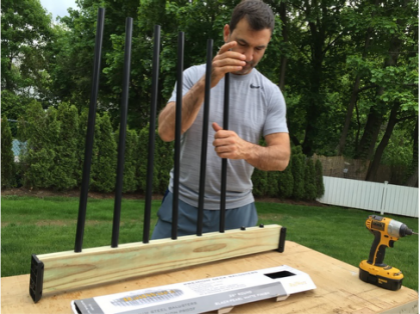
Here are a few steps on how to install metal round or square balusters into a wooded top and bottom rail system. We offer multiple sizes, colors and are available in ¾” round or square.
- Measure the distance between your structural rail posts. You can subtract ¼” if you choose to use our railing connectors. This is recommended for many reasons. One, it creates a stronger bond than toe nailing or screwing upper and lower rails to your posts. Secondly, eliminates the chance of the rails expanding and extracting during the seasons causing unwanted gaps.
- Cut the 2x4 top and bottom rails to the proper lengths. We suggest that you use a miter saw and cut each railing section one at a time. Then clamp the two rails together.
- Mark the center of your rails. Make your marks on the inside faces on both the upper and lower rails. These marks will act as a guide as you lay out and screw in your baluster connectors.
- We recommend making a line at 4”. This will be the center mark for your baluster connector. By doing this the spaces in between balusters should be 3-3/4”. This will be in line with most codes for correct baluster spacing.
- Be sure to screw in the baluster connectors into the center of the 2x4 upper and lower rails.
- Install bottom of the lower rail no more than 3-1/2” above the deck floor, if you are using a 2x4 or 2x6 rail cap with 26" balusters to assemble a 36" high guardrail.
- Push down your balusters into the bottom rail connectors first. Next, work from one end to the other to slide the balusters into the top rail connectors. Secure your top rail to the rail posts using the recommended railing connectors install your top cap to finish the rail.
Installing Face Mount Balusters
Spindles, face mount balusters or flat pickets are the rail infill used to provide safety and esthetics for deck railings. We offer Deckorators or Dekpro face mount balusters. Styles include arc – baroque – traditional – belly and bow. Most building codes prohibit deck railing from having any openings that would allow a 4" ball to pass through. This rule allows the need for an attractive and economical repeated system for filling in the spaces between structural rail posts.
Because of the specific spacing requirements, you will need a lot of spindles or balusters to build out a rail section, even for a short length of rail. Balusters or metal spindles will more than likely be the most expensive rail component for your project, but it will be well worth the cost. Years ago, most deck rail construction consisted of wooden face mount 2x2 pickets nailed to the deck rim and top rail to meet the requirement. This resulted in warped handrails and not the most esthetically pleasing look. And let’s not forget the yearly maintenance to keep these spindles in decent shape. (no one likes to sand and paint on a yearly basis)
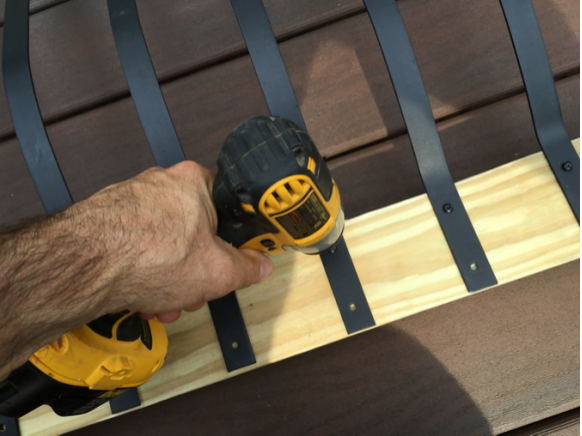
Here are a few steps on how to install metal pickets into a wooded top and bottom rail system
- Measure the distance between your structural rail posts. You can subtract ¼” if you choose to use our railing connectors. This is recommended for many reasons. One, it creates a stronger bond than toe nailing or screwing upper and lower rails to your posts. Secondly, eliminates the chance of the rails expanding and extracting during the seasons causing unwanted gaps.
- Cut the 2x4 top and bottom rails to the proper lengths. We suggest that you use a miter saw and cut each railing section one at a time. Then clamp the two rails together.
- Mark the center of your rails. Make your marks on the inside faces on both the upper and lower rails. These marks will act as a guide as you lay out and screw your face mount balusters.
- We recommend making a line at 4”. This will be the center mark for your baluster. By doing this the spaces in between balusters should be 3-3/4”. This will be in line with most codes for propper baluster spacing.
- Be sure to screw in the baluster into the center of the 2x4 upper and lower rails.
- Install bottom of the lower rail no more than 3-1/2” above the deck floor, if you are using a 2x4 or 2x6 rail cap with 26" balusters to assemble a 36" high guardrail.